How Are Moving Blankets Used for Fitness Equipment Transport?
Fitness equipment is among the most challenging categories of items to move. A commercial treadmill weighs 150 to 250 kilograms, has a fragile display console, exposed belts and rollers, and a heavy motor that can shift during transport. A multi-station gym or a set of dumbbells adds further complexity. Unlike furniture, fitness equipment often has sharp edges, protruding handles, and delicate electronic components that cannot be removed for transport. The Moving Blanket is the primary protective tool for this task, but not every blanket is suitable. A standard furniture blanket may be too thin to absorb the impact of a 200-kilogram treadmill, and it may not provide enough coverage for the long, irregular shape of a rowing machine. For procurement managers at moving companies, gym equipment distributors, and fitness facility relocation specialists, understanding how Moving Blankets are used for fitness equipment transport is essential for preventing damage and controlling costs.
This guide is written for buyers who need to source Moving Blankets for fitness equipment transport. We will explain the specific challenges of moving gym equipment, the types of blankets that are suitable, the wrapping methods that protect different equipment types, the specifications to include in a purchase order, and the criteria for evaluating a supplier. We will also provide detailed product parameters from our factory at Wenzhou Top Packaging Co., Ltd. Whether you are moving a single home gym or relocating a commercial fitness center, this guide will help you select the right Moving Blankets for the job.
Table of Contents
- 1. Why Is Fitness Equipment Harder to Move Than Furniture?
- 2. What Type of Moving Blanket Is Suitable for Gym Equipment?
- 3. How Do You Wrap Different Types of Fitness Equipment?
- 4. What Specifications Should Buyers Include in a Purchase Order?
- 5. How Do You Evaluate a Moving Blanket Supplier for Fitness Equipment?
- 6. What Are the Key Product Parameters from Our Factory?
- 7. Frequently Asked Questions (FAQ)
- 8. Conclusion
1. Why Is Fitness Equipment Harder to Move Than Furniture?
Fitness equipment presents a unique set of challenges that differ from standard furniture moving. The first challenge is weight distribution. A treadmill, for example, has a heavy motor at the front and a lighter deck at the rear. If the equipment is lifted or transported without proper support, the frame can bend or the motor can shift. The second challenge is fragile components. The display console, the touchscreen, and the sensors are delicate and expensive to replace. The third challenge is exposed moving parts. Belts, rollers, and cables can be damaged if they are not secured during transport. The fourth challenge is sharp edges and protrusions. Weight stacks, handles, and foot pedals can tear through a thin blanket and damage the equipment or the truck interior. The table below summarizes the specific challenges of fitness equipment transport.
| Challenge | Example | Risk if Not Addressed |
| Uneven Weight Distribution | Treadmill motor at front | Frame bending, motor shift |
| Fragile Components | Display console, touchscreen | Cracked screen, broken electronics |
| Exposed Moving Parts | Belts, rollers, cables | Damage to belts, misalignment |
| Sharp Edges and Protrusions | Weight stacks, handles | Torn blankets, damaged equipment |
| Large Footprint | Multi-station gym | Difficult to wrap and secure |
At Top Packaging, our factory manufactures Moving Blankets specifically for the demands of fitness equipment transport. We understand that the blanket must be thick enough to absorb impact, large enough to cover the equipment, and durable enough to resist tearing on sharp edges. Our blankets are designed to meet these requirements.
2. What Type of Moving Blanket Is Suitable for Gym Equipment?
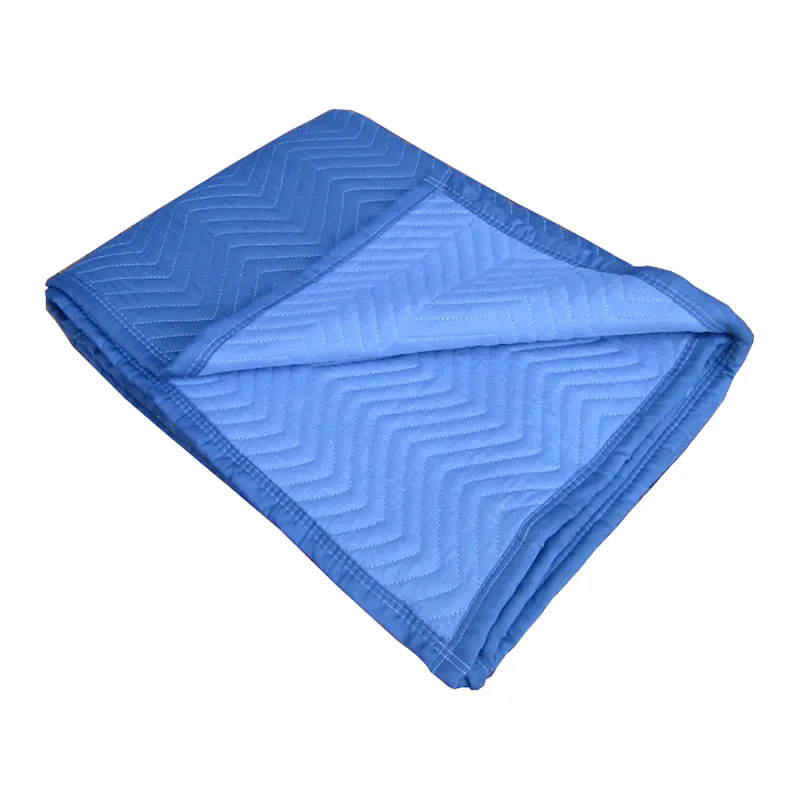
Not every Moving Blanket is suitable for gym equipment. The blanket must have a higher weight and density than a standard furniture blanket to handle the weight of treadmills, ellipticals, and weight machines. A heavy-duty blanket, typically 3.0 to 4.0 kilograms, is recommended for most fitness equipment. The blanket should also be large enough to cover the equipment completely, with enough overlap to secure the edges. A common size is 200 x 250 centimeters, which can wrap around most home gym equipment. For commercial equipment, a larger size or multiple blankets may be required. The table below summarizes the blanket specifications for different types of fitness equipment.
| Equipment Type | Recommended Blanket Weight | Recommended Blanket Size | Number of Blankets |
| Treadmill | 3.0 - 4.0 kg | 200 x 250 cm | 2 |
| Elliptical | 3.0 - 4.0 kg | 200 x 250 cm | 2 |
| Rowing Machine | 2.5 - 3.5 kg | 150 x 200 cm | 1 - 2 |
| Weight Bench | 2.0 - 3.0 kg | 150 x 200 cm | 1 |
| Multi-Station Gym | 3.5 - 4.0 kg | 200 x 300 cm | 3 - 4 |
| Dumbbell Rack | 3.0 - 4.0 kg | 200 x 250 cm | 2 |
At our factory, we produce Moving Blankets in a range of weights and sizes to suit different fitness equipment types. We can also produce custom sizes for oversized equipment. Our sales team can help you select the right blanket for your specific equipment.
3. How Do You Wrap Different Types of Fitness Equipment?
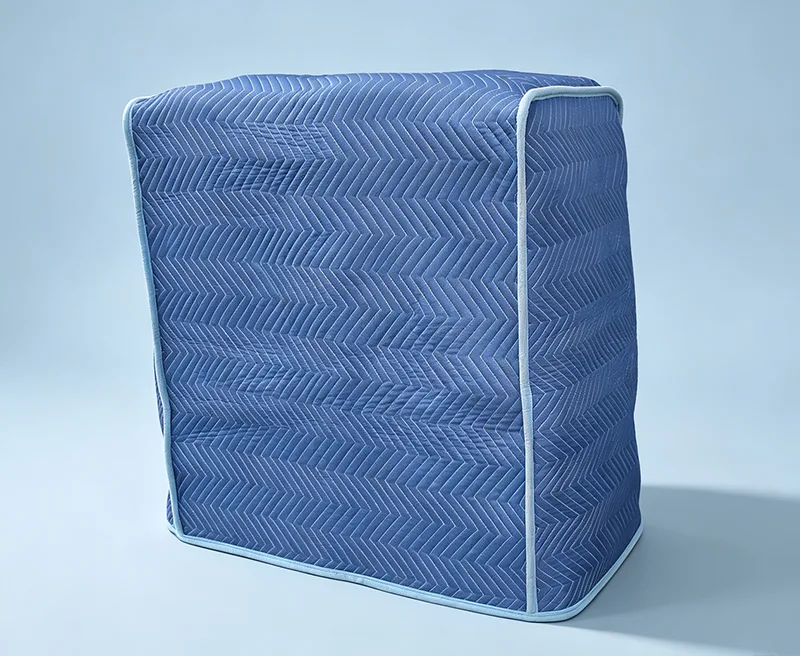
Wrapping fitness equipment with Moving Blankets requires a methodical approach that addresses the specific vulnerabilities of each equipment type. The general principle is to cover all exposed surfaces, secure the blanket in place, and protect fragile components with additional padding. The table below outlines the wrapping method for common fitness equipment types.
| Equipment Type | Wrapping Method | Additional Protection |
| Treadmill | Wrap blanket around the deck and motor housing, secure with tape or straps | Pad the console with foam or a second blanket |
| Elliptical | Wrap each arm separately, then wrap the main body | Protect the display with a foam pad |
| Rowing Machine | Wrap the rail and the flywheel housing separately | Secure the seat and handle with straps |
| Weight Bench | Wrap the pad and the frame together | Pad the adjustment pins |
| Multi-Station Gym | Wrap each station separately, then wrap the frame | Protect the weight stack with foam |
| Dumbbell Rack | Wrap the rack frame, then secure the dumbbells | Use edge protection on the rack corners |
At Wenzhou Top Packaging Co., Ltd., we provide wrapping guidance with every order of Moving Blankets for fitness equipment. Our technical team can advise on the best wrapping method for your specific equipment. We also offer accessories such as straps, tape, and edge protectors to help secure the blankets.
4. What Specifications Should Buyers Include in a Purchase Order?
When purchasing Moving Blankets for fitness equipment transport, the buyer should include detailed specifications in the purchase order to ensure that the product meets the required performance and durability standards. The key specifications are the size, the weight, the filling material, the outer shell material, the quilting pattern, the edge binding, and the packaging. The size should be specified in centimeters or inches. The weight should be specified in kilograms. The filling material should be specified by type (e.g., recycled cotton, foam). The outer shell material should be specified by type (e.g., cotton, polyester). The quilting pattern should be specified by type (e.g., diamond, box). The edge binding should be specified by material and type. The packaging should be specified by the number of blankets per bale. The table below summarizes the specifications that should be included in a purchase order.
| Specification | Unit of Measure | Example |
| Size | cm or inches | 200 x 250 cm |
| Weight | kg | 3.5 kg |
| Filling Material | Type | Recycled cotton |
| Outer Shell Material | Type | 100% cotton |
| Quilting Pattern | Type | Diamond |
| Edge Binding | Material and type | Polyester, double-stitched |
| Packaging | Units per bale | 10 blankets per bale |
At our factory, we work with our customers to ensure that all specifications are clearly defined and understood before production begins. We provide samples for approval and maintain strict quality control throughout the production process. Our goal is to deliver Moving Blankets that meet or exceed our customers' expectations.
5. How Do You Evaluate a Moving Blanket Supplier for Fitness Equipment?
Evaluating a supplier of Moving Blankets for fitness equipment transport requires a focus on material quality, weight consistency, durability, and technical support. The supplier must use high-quality fibers that provide consistent density and impact absorption. They must control the quilting process to ensure that the filling is evenly distributed. They must test the blankets for durability and tear resistance. And they must provide technical support to help you select the right blanket and wrapping method. The table below summarizes the evaluation criteria.
| Evaluation Criterion | What to Look For | Why It Matters |
| Material Quality | High-quality recycled cotton, durable outer shell | Ensures impact absorption and durability |
| Weight Consistency | Consistent weight and thickness across batches | Ensures reliable protection |
| Durability Testing | Tear resistance, abrasion resistance | Ensures blanket withstands sharp edges |
| Technical Support | Wrapping guidance, product selection | Helps protect equipment effectively |
| Project Experience | References in fitness equipment moving | Demonstrates capability and reliability |
At Top Packaging, our factory has been producing Moving Blankets for over a decade. We use high-quality recycled cotton and durable outer shells, and we test our blankets for tear and abrasion resistance. Our technical team provides wrapping guidance and product selection support. We invite you to evaluate us against these criteria and to consider us as your partner for Moving Blankets.
6. What Are the Key Product Parameters from Our Factory?
The following table provides the key product parameters for our Moving Blankets. These blankets are designed for fitness equipment transport, as well as furniture and general moving applications. Our factory can also produce custom blankets to meet specific requirements.
| Parameter | Specification Range | Notes |
| Size | 150 x 200 cm to 200 x 300 cm | Custom sizes available |
| Weight | 2.0 kg - 4.0 kg | Heavy-duty for fitness equipment |
| Filling Material | Recycled Cotton, Polyester, Foam | Selected for impact absorption |
| Outer Shell | Cotton, Polyester, Blend | Selected for durability |
| Quilting Pattern | Diamond, Box, Channel | Selected for protection uniformity |
| Edge Binding | Polyester, Double-Stitched | Prevents fraying |
| MOQ | 500 pieces | Negotiable for large orders |
| Lead Time | 2 - 4 weeks | Depends on quantity and customization |
At our factory, we manufacture our Moving Blankets to meet these specifications and more. We can customize the size, weight, filling material, and quilting pattern to suit your specific requirements. Our quality control system includes inspection of raw materials, in-process inspection, and final inspection before shipment. Our goal is to provide our customers with high-quality Moving Blankets that protect their fitness equipment during transport.
7. Frequently Asked Questions (FAQ)
Question 1: How many moving blankets do I need to move a treadmill?
Answer: A treadmill typically requires two heavy-duty Moving Blankets (3.0-4.0 kg each). One blanket is used to wrap the deck and motor housing, and the second is used to pad the console and the front of the machine. If the treadmill is being transported in an open truck or with other equipment, a third blanket may be used for additional protection.
Question 2: Can I use standard furniture blankets for fitness equipment?
Answer: Standard furniture blankets are usually too thin and too light for fitness equipment. A treadmill or elliptical can weigh 150-250 kg, and a standard blanket may not absorb the impact or resist tearing on sharp edges. For fitness equipment, we recommend heavy-duty blankets of 3.0-4.0 kg with a durable outer shell and double-stitched edges.
Question 3: How do I protect the display console during transport?
Answer: The display console is one of the most fragile parts of fitness equipment. Wrap the console with a foam pad or a small blanket, and then secure it with tape or a strap. Do not place heavy items on top of the console. If the console is removable, consider removing it and packing it separately in a padded box.
Question 4: Can moving blankets be reused for multiple moves?
Answer: Yes, Moving Blankets are designed to be reused. After each move, inspect the blanket for tears, worn spots, or contamination. Clean the blanket by shaking out debris and spot-cleaning with mild detergent. Store it in a dry, clean area. With proper care, a high-quality Moving Blanket can last for many moves.
Question 5: What is the best way to secure a moving blanket on a treadmill?
Answer: Wrap the blanket around the treadmill and secure it with packing tape or straps. Make sure the blanket covers all sharp edges and protrusions. Use additional padding on the console and the motor housing. Check the blanket before transport to ensure that it is secure and will not slip during the move.
8. Conclusion
Moving Blankets are essential for fitness equipment transport because they protect heavy, irregular, and fragile equipment from impact, abrasion, and damage. The right blanket for fitness equipment is heavy-duty, large enough to cover the equipment, and durable enough to resist tearing on sharp edges. By understanding the specific challenges of fitness equipment transport, selecting the right blanket specifications, and using the correct wrapping method, buyers can protect their equipment and reduce the risk of costly damage. At Wenzhou Top Packaging Co., Ltd., our factory manufactures heavy-duty Moving Blankets that meet the demands of fitness equipment transport. We use high-quality materials and rigorous quality control to ensure that our blankets provide reliable protection.
Whether you are moving a single home gym or relocating a commercial fitness center, we invite you to contact us to discuss your requirements. We can provide samples, technical data, and customized solutions. Our commitment to quality and customer satisfaction has made us a trusted partner for moving companies and equipment distributors around the world.
Contact Wenzhou Top Packaging Co., Ltd. today to discuss your Moving Blanket requirements and discover how our products can protect your fitness equipment during transport.
Previous :
-
Related News
- How Do Moving Blankets Absorb Impact During Transportation?
- Why Do Moving Blankets Reduce Friction Between Items?
- How Do Moving Blankets Protect Appliances During Delivery?
- When Should You Use Moving Blankets Instead of Foam?
- Why Are Moving Blankets Essential for Furniture Protection?
- What Makes an Economy Moving Blanket the Smartest Choice for Protecting Your Furniture During a Move?
Leave me a message
New Products
News Recommendations